
Florida, affectionately known as the “Sunshine State” is located in the South-eastern United States. Most of its land area is a large peninsula between the Gulf of Mexico and the Atlantic Ocean, and as such the climate is highly affected by its maritime location. It is bordered by Alabama and Georgia to the north.
The northern parts of the state have a humid subtropical climate, while the southern section is tropical.
Wetlands like the Everglades are common throughout Florida and as a result, the state is rich in biodiversity and a plethora of birds. Many bird species also breed in Florida due to its mild climate and warm waters.
If you live in or are visiting Florida and are a keen birdwatching enthusiast, this article will help you identify them right in your own backyard or as you tour around the area.
What are some of the most common Florida backyard birds?
1. Red-winged Blackbird

Red-winged blackbirds are one of the most common medium-sized songbirds native to North America and found year-round in Florida. They have one of the most distinctive sounds that you will hear in a Florida marsh. They are typically found near water sources and also around agricultural fields.
The males are striking birds that are completely black with red shoulder patches, and white wing bars. The females are brown-black with faintly marked wings.
Red-winged blackbirds migrate in flocks of up to 2,000 birds. They breed in the boreal and temperate forests, mostly in North America, and spend their winters in the southern United States and Central America.
2. Eastern Bluebird
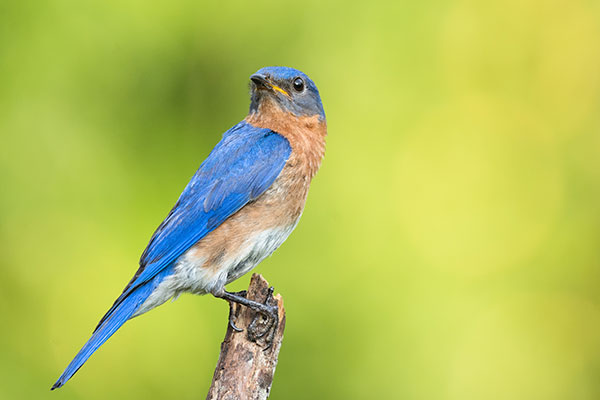
Eastern Bluebirds are small songbirds of the thrush family, native to North America, and are found all year around in Florida. They have compact bodies, short strong legs and long pointed bills. They prefer areas with trees and shrubs. Eastern Bluebirds have a diverse diet which ranges from insects to fruit, but they prefer to eat insects, berries, and caterpillars.
The males are a vibrant royal blue on the back and head, and warm red brown on the breast. The females have blue tinges on their wings and tail, but their colors are not as vibrant as the males.
3. Painted Bunting

The painted bunting is a small passerine songbird in the cardinal family that breeds from the eastern Great Plains and the Gulf Coast of Florida to southern Quebec and New Brunswick. Florida is the only state with a breeding and wintering population of these colorful birds. Even though they are fairly common birds in much of Florida during the summer, they are rarely seen, as they prefer to inhabit deep brush, except when the males perch on top of a bush to sing early in the mornings. Although they are primarily seed eaters, Painted Buntings rarely come to backyard feeders because they dislike being so far from cover. They also feed on insects.
The male is reminiscent of a rainbow, covered in splashes of red, green, blue and yellow. The females and juveniles are bright yellow-green.
4. Northern Cardinal

The Northern Cardinal is the most common bird found in Florida and can be seen all year around. It is a medium-sized songbird, about the size of a robin. It is native to North America.
Northern Cardinals are known for their reddish color and the pointed crest on their head, which they can raise to show aggression. They have a solid red color on their chest and head. The male has a black mask that covers the upper half of his face, while the female has a brown mask.
These birds are able to migrate long distances in order to find new food sources.
5. Gray Catbird
The Gray Catbird is a medium-sized North American and Central American perching bird. It is from the mimid family, meaning that it mimics sounds. In some areas it is known as the slate-colored mockingbird, although this is not the case.
Males and females cannot be distinguished apart by their looks. They are a plain lead-gray color. The back of the head is a slightly dark shade of gray. With a rust-colour under tail. The slim bill, the eyes, and the legs and feet are also blackish. Different behaviour in the breeding season is usually the only clue of the difference between the males and females.
Gray Catbirds are named for their cat-like call. But because of their well-developed songbird syrinx, they are able to make two sounds at the same time. A gray catbird’s song is easily distinguished from that of the mockingbird because the mockingbird repeats its phrases or “strophes” three to four times, the thrasher usually twice, but the catbird sings most phrases only once. The catbird’s song is usually described as more raspy and less musical than that of a mockingbird.
In contrast to the many songbirds that choose a prominent perch from which to sing, the catbird often elects to sing from inside a bush or small tree, where it is obscured from view by the foliage.Catbirds are found along the Atlantic Coast. Some migrate from North America spend winters along the Gulf Coast from Florida through to Texas and down Central America to the Caribbean.
6. Carolina Chickadee

The Carolina Chickadee is a common sight all year around. This small songbird is found in North Carolina and various other states such as Florida, Texas, and Tennessee among others. These birds are active during the day and live in the forested areas of these states. They have a very distinctive call that you can hear for miles away.
The Carolina Chickadee is only about five inches long. It has a black cap and bib separated by stark white cheeks.
They are known to migrate to Central America, Mexico, and the northern regions of South America during the winter months. Male and female chickadees take different migration routes, with females flying further south than males. These migrations are due to seeking out food sources.
7. American Crow

The American Crow is a large passerine, with all black plumage.
They are one of the most intelligent birds in North America and can be found all over but tend to prefer urban areas to rural areas. They are omnivores, which means that they eat plant and animal matter.
The American Crow is about the size of the Common Raven, but with a larger bill. The bill will usually be yellow in color with a pinkish cast. The legs and feet are black, and the eyes are dark brown.
Crows are known for their intelligence and resourcefulness. They are considered to be the most intelligent of all birds, and even of all animals. As a result, they have been able to adapt to a wide variety of environments, including many urban centres. One behavior that has helped them survive in these areas is the ability for some members (usually males) of the group to migrate.
8. Eurasian Collared-Dove
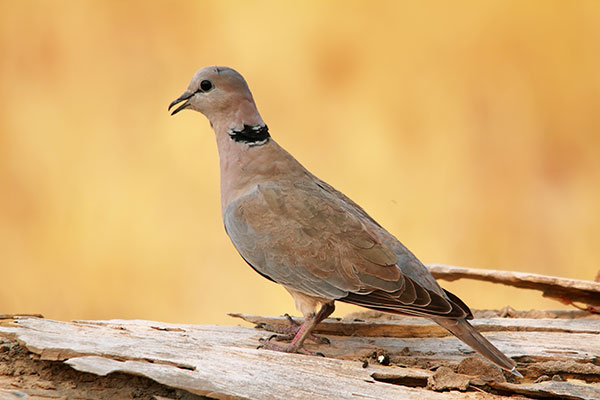
The Eurasian Collared-Dove is not a migratory bird. They have a wide distribution in the USA. Over the last century, the Eurasian Collared-Dove has been one of the great colonisers of the bird world. They feed close to human habitation, and also visit bird tables. The largest populations are found on farms around grain stores. Flocks commonly number between 10 and 50.
The Eurasian Collared-Dove is a medium-sized dove, distinctly smaller than the wood pigeon, but a similar length to a rock pigeon, although slimmer and with a longer tail. There is no difference between males and females. They are grey-buff to pinkish-gray, and darker on top, with a blue-grey underwing patch. The tail feathers are grey-buff above, and dark grey and tipped white below; the outer tail feathers are also tipped whitish above. It has a black half-collar edged with white on its nape from which it gets its name. The short legs are red and the bill is black. The eye is surrounded by a small area of bare skin, which is either white or yellow.
The Eurasian collared dove makes a harsh loud screeching call lasting about two seconds, particularly in flight just before landing.
9. Mourning Dove

Mourning doves are small songbirds that live in North America and can be seen perching on telephone wires. They are very sensitive to habitat changes and can be found in rural and suburban areas throughout the year. They are primarily granivores and forage for seeds on the ground; their flight is fast and bullet straight. Their soft, drawn-out calls sound like a lament, hence the name “Mourning Dove”.
Graceful and slender-tailed, with a small-head, mourning doves are light gray and brown and generally muted in color. Males and females are similar in appearance. The species is generally monogamous.
10. Crested Flycatcher
The Crested Flycatcher is one of the easiest birds to spot, especially in Florida.
It has a gray head, lemon-yellow belly and cinnamon sides and tail, and is among the more colorful members of its family. It has a rather large head and a relatively long, stout bill. Males and females look alike.
They are mostly migratory birds, but there is a year-round population that resides in the southern half of Florida’s peninsula.
Crested flycatchers prefer deep forests, open woods and the edges of woods. In Florida, they are found in the suburbs as well. They tend to perch high in the tree canopy, where they can defend their territory and hunt for insects, including wasps, butterflies, beetles, dragonflies, grasshoppers and more. They also eat a variety of fruit, including elderberry, cherries and blackberries.
11. Blue-gray Gnatcatcher
The Blue-grey Gnatcatcher is a small, active songbird that doesn’t sit still for long. They are always flitting from branch to branch in search of small insects and have constantly twitch their tails from side to side, this they do to scare up insects to eat. Contrary to the name, the blue-gray gnatcatcher, is not fond of gnats.
They are 4 1/2 inches long with a thin bill, white eye ring and are blue grey on their upper parts, white under parts and a long black tail with white outer feathers.
Their habitat is open woods. hardwood swamps, pinelands, sandhills, even the suburbs. They make no secret of their presence through song and incessantly hop and flit from limb to limb and tree to tree, in search of a good meal.
The Blue-gray Gnatcatcher is a migratory bird. They are a common winter visitor in South Florida, but have year-round populations in the north. They have been found nesting in all of Florida’s 67 counties.
12. American Goldfinch

American Goldfinches can be found in most of North America and are spotted in Florida during winter.
American Goldfinches are popular birds with the males’ bright yellow and black coloring in spring. The females are duller brown, as are males in winter.
They can be found in weedy fields and overgrown areas foraging for sunflower, thistle, and aster plants. They are also common in suburbs, parks, and backyards.
13. Boat-tailed Grackle
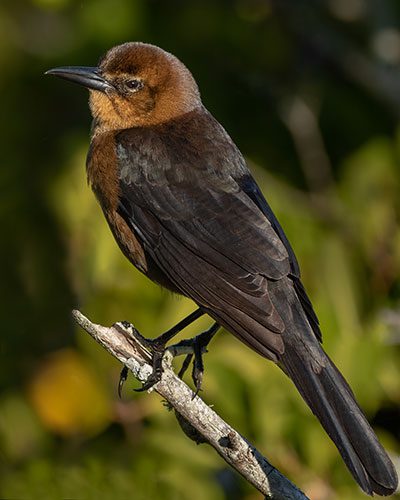
Boat-tailed Grackles have a fairly complex social structure. They form colonies, where males fight to be the king of the roost and the mating rights that go with it.
They are large birds, with a body length of about 15 inches and a wingspan that can be 20 inches or more. Males are larger and darker than females, which have brown heads and necks and grayish bodies. Boat-tailed Grackles are more slender than crows and have a narrower bill and a long tail.
Their range extends along the Gulf and Atlantic coasts from Texas to New York and Connecticut. Although it is only in Florida that they venture inland.
Although boat-tailed grackles have become part of the urban scene in Florida, they are by nature marsh birds, generally, nesting in tangles of bulrush, fireflag and similarly tall, reedy aquatic plants.
Boat-tailed grackles forage near and in water for insects, snails, crayfish, frogs, fish and shrimp. They also eat seeds, scraps of food and will take the eggs and young of other birds. They can be pests in agricultural areas but are protected under the Migratory Bird Species Act.
14. Ruby-throated Hummingbird
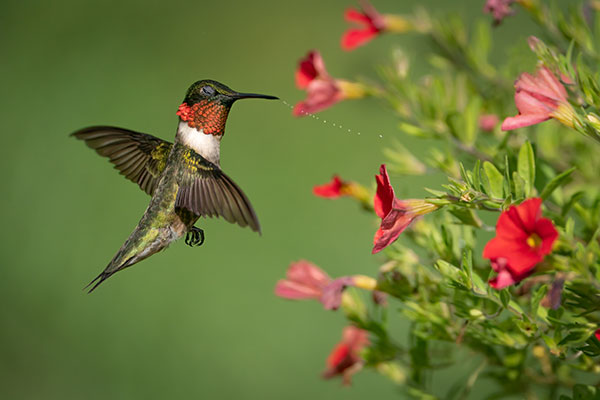
Ruby-throated hummingbirds can be found in the eastern United States, into Canada and in Florida during the summer. One of their main food sources is the nectar from flowers.
They are the only hummingbird species with a red patch on their throat; males have a red throat, whereas females have a black throat. Their tail feathers are green with white stripes.
Ruby-throated hummingbirds are some of the most migratory birds in North America, migrating to the southern United States and Mexico.
15. Blue Jay
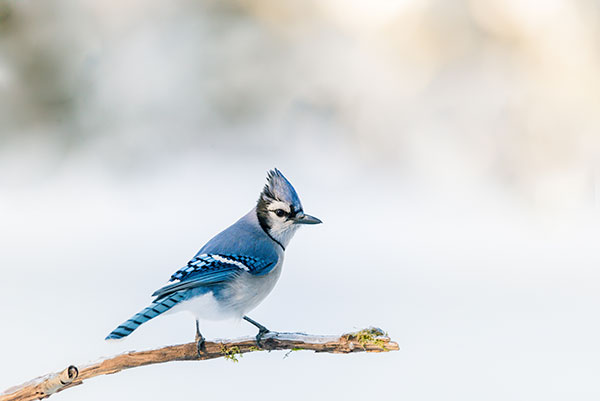
The Blue Jay is a medium sized bird and is a member of the crow family. It is native to North America and is common across the continent. The species has adapted well to human developments, often nesting in and around residential areas.
Blue Jays have a long, pointed tail and a crest. The head, wings and back are blue while the chest is white. Both genders have similar features, but the female is slightly smaller in size than the male.
Blue jays are known to be egg thieves, sometimes directly taking eggs from nests and other times following the special sounds made by parent birds.
16. Florida Scrub-Jay
The Florida Scrub-Jay is federally listed as a threatened species and it is endemic to the state of Florida, they are found nowhere else in the world.
Florida Scrub-Jays are robin-sized birds. They live in flocks, and family groups take turns to watch for danger while the others feed on insects, berries and seeds. They love acorns and one adult may cache thousands of them throughout the fall. They are reluctant to fly across non-oak-scrub habitat and rarely stray from the area where they hatched. Young birds stay with their parents until they can obtain a territory of their own.
Florida Scrub-Jays are a dull blue overall with a whitish forehead and a pale gray back and belly.
17. Purple Martin
The Purple Martin is a passerine bird in the swallow family and is the largest swallow in North America.
Despite its name, it is not truly purple. The dark blackish-blue feathers have an iridescent sheen in the light that gives them a bright blue to navy blue or deep purple appearance. They are known for their speed, agility, and their characteristic mix of rapid flapping and gliding flight pattern. When approaching their nesting site, they will dive from the sky at great speeds with their wings tucked back.
Purple Martins are migrants that only fly during the day and forage as they go. They are one of the earliest South American migrants to arrive in the spring, reaching Florida as early as mid-January.
18. Northern Mockingbird

Probably the most notorious of the Florida backyard birds, is the Mockingbird. This is because they are good at mimicking other animals, sirens and crickets, as well as their own species. Studies have shown that the Mockingbird can sing up to 200 songs, including the songs of other creatures like birds, frogs and other animals.
The Northern Mockingbird was adopted as the Florida state bird in 1927. Not only a Florida favorite, it is also the state bird of Arkansas, Mississippi, Tennessee, and Texas.
Their diet consists mainly of insects, fruits, and nectar. They migrate to the Southern United States to escape the colder winters.
19. White-breasted Nuthatch
White-breasted Nuthatches are common visitors to backyard bird feeders in Florida.
Both sexes look the same, except the males have a black cap on the top of their heads, whereas the females display more of a gray crown. They have distinctive white cheeks and chests.
You will find these nuthatches in Florida in deciduous forests. Although they prefer to live in deciduous forests, they adapt well to the presence of humans and are often seen at parks, cemeteries, and wooded backyards.
21. Baltimore Oriole

The whistling songs of Baltimore Oriole’s can be heard all year around in Florida. These birds spend most of their time at the tops of deciduous trees, fluttering around, building beautiful woven nests, and looking for food. They are most often found in open woodlands, riverbanks, and on the edges of swamps and forests. American orioles are in the same family as blackbirds and meadowlarks.
Males are a combination of orange and black with white wing bars with a black hood and back. Females have slightly duller colors than the males without a black hood and back.
Baltimore Orioles were named because of their bold orange-and-black plumage, which were the same colors as the heraldic crest of England’s Baltimore family (who also gave their name to Maryland’s largest city).
Baltimore Orioles sometimes use their slender beaks to feed in an unusual way, called “gaping”. They stab the closed bill into soft fruits, then open their mouths to cut a juicy swath from which they drink with their brushy-tipped tongues.
22. Northern Parula
The northern parula, is one of the few warblers to be seen year-round in various places in the Sunshine State. Their diet consists mainly of bugs, beetles, flies, ants, spiders and the like. They will dart after their prey, forage on the ground or will hover to pick a bug off a leaf. They also eat berries.
They have a small, short-tail, a sharply pointed, bicolored bill. They are blue-gray above with a mossy-green patch on the back, white eye-arcs, and yellow breast. Adult males have most extensive black and rufous breast band. Both sexes are similar, but females are a duller coloration.
They Breed in mature coniferous or deciduous forests, especially near water and build their nests using moss.
23. Eastern Phoebe

Eastern phoebes are mostly migratory birds, breeding in Canada’s far north during the summer and most of the eastern United States, then traveling south into Florida, Mexico and parts of the Caribbean to spend the winter. In recent decades, there have been a few Eastern Phoebes found nesting as far south as Everglades National Park.
The Eastern Phoebe is a grayish-brown bird with a dark cap, long dark tail, and white rump. It has a long, thin bill that curves up slightly at the end.
They eat flying insects.
24. American Robin
American Robins are common winter visitors to Florida. They gather in flocks around fruit trees and along roadsides. In spring, most robins migrate north to breed.
American robins are medium-sized, mostly slender birds with pointed bills. They have a long tail that is usually drooped, which helps them to balance in trees. Their plumage is predominately brownish-gray on their upperparts and they have a white or cream throat, breast and belly. The male has a reddish-orange patch in the front of his otherwise brown head while the female’s coloring is less vibrant.
25. Chipping Sparrow
The chipping sparrow is a small, ground-dwelling bird. They are common and widespread throughout most of North America. Usually found in open woodlands, scrubby areas, or even in suburban settings. They often gather in flocks in fall and winter. They are frequently heard singing a fairly dry trill.
The Chipping Sparrow is small and slender, with a grayish breast, rusty cap, and black eyeline in breeding season. The coloring is not as bright in winter, but it still shows a brown cap and dark eyeline. Juveniles are extensively streaky. The male and female are similar in appearance, but the male is slightly more colorful.
They migrate south in winter and can be found in Florida backyards during this time.
26. European Starling

Starlings are migratory birds that have adapted to the agricultural landscapes of Europe. They are found all year around in Florida.
The European Starling is a stocky blackbird with a short tail and long, slender beak. In flight their wings are short and pointed, giving them a star-like appearance, and hence the name “starling”. At a distance, starlings appear black. In summer, they turn an iridescent purplish-green with yellow beaks; in winter their plumage is brown, covered in brilliant white spots.
Individuals breeding in Florida probably do not migrate, but migrants from further north increase the winter populations.
27. Tree Swallow

Tree Swallows are winter residents in Florida. They migrate down from the northern United States and from all over Canada. When in flight, they are often in large flocks, and adults can be identified by their dark upperparts, white underparts, triangular wings with greenish underwing linings, and notched tail. The Tree Swallow is often mistaken for the Purple Martin in early spring.
Adult males are blue-green above and white below with blackish flight feathers and a thin black eye mask; females are duller with more brown in their upperparts.
Their diet is mostly insects, especially in summer. They also eats some spiders, and will eat sand fleas (which are crustaceans). Unlike our other swallows, Tree Swallows eat a considerable diet of vegetable material (mostly in winter).
28. Tufted Titmouse
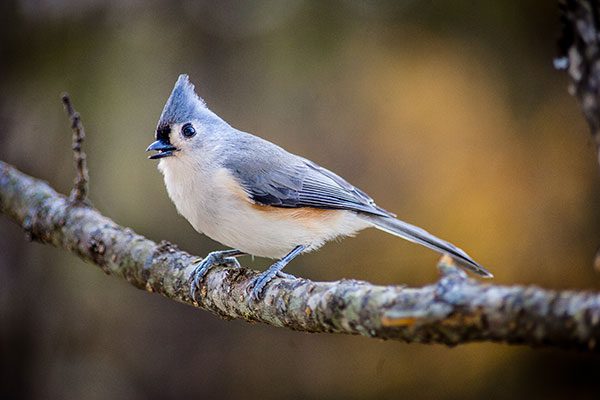
Tufted Titmice live in deciduous or mixed evergreen-deciduous woods, i.e. they typically live in areas with a dense canopy and many tree species. They are also common in orchards, parks, and suburban areas. Generally found at low elevations such as in Florida.
Tufted Titmice are very assertive over smaller birds, pushing in to get to the food first. They mostly eat insects in summer, such as caterpillars, beetles, ants, and wasps, as well as spiders and snails. They will also eat seeds, nuts, and berries and will hoard shelled seeds.
The Tufted Titmouse is gray on the back and white underneath with a gray crest and large eyes. They often flock with chickadees, nuthatches, and woodpeckers.
29. Eastern Towhee
Eastern Towhees are part of the sparrow family and the most frequently spotted sparrows during summer in Florida and the third most spotted during winter.
They are striking large sparrows, about the size of Robin, with a black head, throat, and back, reddish sides, long tails, and a white belly in the males. Females are similar but brown instead of black.
You can find Eastern Towhees rummaging in the undergrowth and along the edges of forests and thickets.
30. Palm Warbler
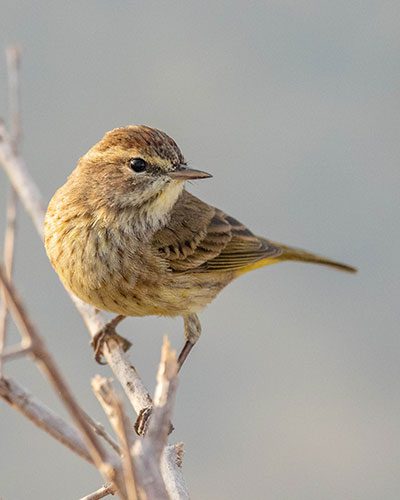
The Palm Warbler is a subtly patterned brown-and-yellow warbler, known for constantly bobbing its tail. It is one of the more common warblers wintering in the southern U.S.. Palm warblers forage on the ground much more than other warblers, sometimes flying to catch insects. They also eat berries.
Male breeding plumage shows a rufous cap. In fall and winter, look for a pale eyebrow and dark line through the eye, diffused streaks on underparts, and bright yellow undertail coverts. There are two populations: “Western” is browner overall, brightest on the undertail coverts; “Yellow” is more suffused with yellow overall; they overlap extensively in range, especially during the fall migration. Palm Warblers breed in bogs and clearings in the boreal forest.
They migrate to the South-eastern United States, the islands of the Caribbean into South America to winter. They are one of the earlier migrants to return to their breeding grounds in the spring, often completing their migration almost two months before most other warblers.
31. Pine Warbler
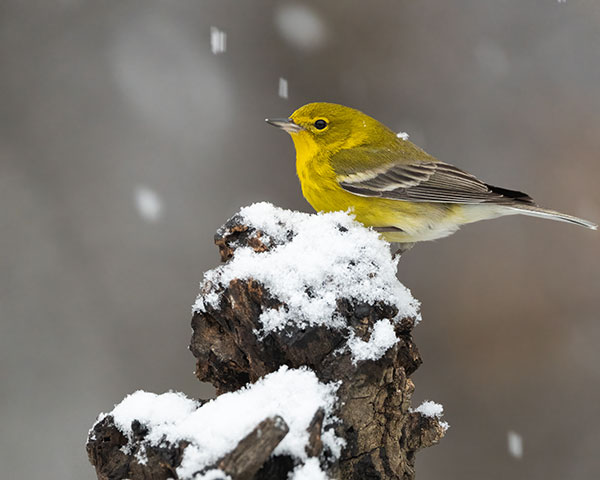
A warbler is “one who warbles”. The word warble comes from an Old French word meaning “to sing with trills and quavers”. The Pine Warbler is a medium-sized, rather robust and long-tailed warbler, with a noticeably stout bill. They are mostly found in pine trees throughout the year.
Pine Warblers have a variable plumage, from the bright yellowish adult male birds with olive backs, whitish bellies, and two prominent white wingbars on gray wings, to the duller colored females. They have large bill, and long narrow tail with a shallow notch.
They occasionally visit feeders, especially for suet. They are short-distance migrants, wintering entirely in the United States.
32. Downy Woodpecker
The Downy Woodpecker is the smallest Woodpecker in Florida and is also the smallest woodpecker in North America. They are seen slightly more frequently in summer in Florida. Although visually very similar to the Hairy Woodpecker it is a third smaller and with a smaller beak compared to other Woodpeckers. They mostly feed on a variety of insects, especially beetles and ants. They also eat seeds and berries and will eat suet at bird feeders.
They have black and white coloring with a red patch at the back of their heads.
Downy Woodpeckers do not migrate and can be spotted in most states.
33. Pileated Woodpecker
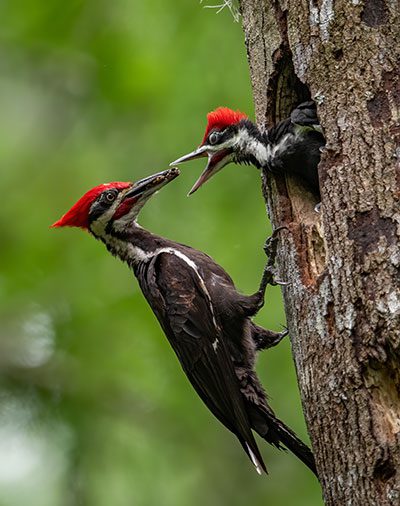
Pileated Woodpeckers are quite common. They makes large excavations in trees to find ants and beetle larvae, their two main food sources. They will also eat suet from backyard bird feeders. They prefer mature forest habitat with large trees and they nest in tree cavities.
Pileated Woodpeckers are black with a red, pointed crest, thin neck & white and black stripes on the face and sides of the birds neck. Males have red foreheads and “moustache”, females have a black forehead and “moustache”.
They don’t migrate and are a highly territorial species. A monogamous pair will inhabit and defend a territory all year round.
34. Red-bellied Woodpecker

The Red-bellied Woodpecker is a small round-headed woodpecker, very common throughout Florida.
The males forehead, crown and hindneck are red. The female’s crown is gray. They have black and white barred wings. The back, head and underside are creamy white to pale gray with a pale red patch on the belly. The male and female stay together only long enough to share in the excavation of a nesting cavity in a dead tree and care for the young, up to 10 weeks after they fledge.
The Red-bellied Woodpecker prefers mature forest habitat and feed on acorns, seeds, fruit and insects.
35. Carolina Wren

Carolina Wrens are shy birds that are dark brown on top and light brown underneath. They have a white eyebrow stripe and upright tail, and a loud ‘teakettle‘ song. They can be found in woods or thickly vegetated areas, and they will visit backyard feeders.
Carolina Wrens do not migrate and are frequently spotted in Florida.
36. House Wren
The House Wren is a very small bird of the wren family and a common bird to be spotted in Florida. Even though they almost never visit bird feeders, they are often seen zipping through backyards while hunting insects.
House Wrens are brown birds that have almost no eye stripe, and overall they are more plain looking than the other wrens that visit Central Florida.
They have a rich bubbly song that is heard during breeding season.
37. Common Yellowthroat
The Common Yellowthroat is a small warbler is found throughout North America in shrubby wet areas, such as marches, forest edges and fields. They hide in thick vegetation, but males often perch conspicuously when singing.
They are a dull olive color with an intense yellow throat. Adult males have black mask bordered above by a white band. Females are duller but always have contrasting yellow throat and undertail coverts.
Some populations remain in Florida all year around and others migrate South in the winter.
Conclusion
Birdwatching is a popular hobby worldwide. The North America region has the most bird species out of any other continent. Each year, nearly a billion people participate in this hobby worldwide, and for many birdwatching enthusiasts, backyard birding has become the best way to experience all that nature has to offer.
Florida backyard birds bring nature to your doorstep.
FAQ
What can I do to encourage wild birds in my yard?
In order to encourage wild birds in your backyard, you must provide a source of water and food. This can be done with bird baths and bird feeders. For a more natural experience, try adding some flowers or plants around your yard to attract different species of birds.
How do I identify the birds around my backyard in Florida?
The best way to identify the birds in your backyard is by looking at their feathers. Their beaks tell you what they like to eat. Their feet tell you if they perch, hop or wade.
What birds are most common in Florida?
For birders, Florida is one of the best birding locations in North America. There are more than 500 bird species recorded in Florida. 37 of the Most Common Backyard Birds in Florida will give you a small preview of what you can find in the Sunshine State.
Are woodpeckers endangered?
Woodpeckers are classified as being at-risk. The number of red, black, and white woodpeckers have been declining over the last seventy years. The main reason for this decrease is the loss of nesting sites due to deforestation, development and expanding agriculture.
Why might there be lots of small birds flying and diving?
It is possible that the birds are looking for food such as flying insects or there could be a predator nearby. Without further observations it is impossible to know what is driving their behavior.
What kind of blackbirds seem to congregate on power lines?
Blackbirds are a common sight at power lines, but why? Scientists believe that the blackbirds congregate at these power lines because this is an excellent place to find food. The electricity can kill bugs, which the blackbirds can easily feed on.