
California is home to a wide variety of backyard birds, from the common house finch to the more rare California scrub jay. Known as The Golden State, California boasts the longest checklist of documented species of birds in the USA. Here are some common backyard birds in California. The variety of birds you see depends on where you are in this beautiful state.
Most Common Backyard Birds in California
1. Red-winged Blackbird

Red-winged blackbirds are medium-sized songbirds and are one of the most common backyard birds in California. They can be found in a variety of habitats including wetlands, marshes, agricultural areas, and suburban parks and gardens, and are found all year round in California.
The males have black bodies with red and yellow stripes on their wings. The females are streaked dark brownish overall, paler on the breast, often showing a whitish eyebrow.
Male red-winged blackbirds are especially known for their loud, beautiful songs. Red-winged blackbirds are year-round residents in California.
The red-winged blackbirds are colonial nesters, which build their nests in close proximity to other red-winged blackbirds. often reusing the same nesting site year after year.
2. Western Bluebird

The western bluebird is a small thrush with blue upper parts and a rusty-orange breast, with a white belly and throat. The female looks like the male but is duller in color. Western Bluebirds are found in open woodlands, often near water sources such as ponds or streams.
These backyard birds are mostly found in the western United States, from British Columbia to Mexico. In California, they are year-round residents in the northern and central parts of the state. Western bluebirds typically form monogamous pairs and use nest boxes for breeding.
3. Bushtit

Bushtits are small, long-tailed birds with gray plumage. The bushtit’s diet consists of small insects and spiders which they glean from the leaves and branches of trees and shrubs. A small part of their diet is also made up of small seeds and other plant materials. They are known for their acrobatic ability to hang upside down from branches while foraging for food. In California, bushtits are year-round residents in the northern and central parts of the state.
These backyard birds are typically found in flocks. They spider webs, moss, and lichens to build their nests.
4. Chestnut-backed Chickadee

The chestnut-backed chickadee is a small bird of the tit family. It is boldly black and white on the head, but the back is a rich chestnut color rather than the gray of other species of chickadee. The back and sides can be chestnut brown or gray.
In California, chestnut-backed chickadees are year-round residents in the northern and central parts of the state. These backyard birds typically form monogamous pairs and use nests made of moss, lichens, and spider webs. Chestnut-backed chickadees are known for their ability to cache food in tree crevices for later consumption.
5. American Crow

The American Crow is a large bird. The plumage is black with a glossy sheen. The legs and bill are also black, and they have dark brown eyes. Males and females look alike, although the female is usually slightly smaller than the male. They are social birds and live in large flocks. Their loud vocal cawing is familiar all over North America. They are highly intelligent birds and their ability to adapt to changing environments has helped them thrive in urban areas. They are also not shy and will often approach people for food.
The American Crow is a scavenger and will eat about anything. Fruits, vegetables, insects, small mammals, carrion, garbage. If something is edible and it is available, then the crow will eat it.
Crows do not migrate but may move around in the same general area in search of food or to find a mate.
In California, it is found in all regions of the state. It can be seen in open areas, such as parks and golf courses, as well as in more urban settings, such as parking lots and city streets.
6. Mourning Dove

Mourning doves are often seen perching on telephone wires. They are very sensitive to habitat changes and can be found in rural and suburban areas throughout the year. Their soft, drawn-out calls sound like a lament, hence the name “Mourning Dove”.
Graceful and slender-tailed, with a small-head, mourning doves are light gray and brown and generally muted in color. Males and females look similar. They are monogamous as a species.
The mourning dove is a seed-eating bird, but they will also eat small fruits and insects.
They are one of the most common backyard birds in California and can be found in almost all regions of the state. While mourning doves will visit backyard bird feeders instead of eating birdseed, prefer sunflower seeds, safflower seeds, and cracked corn.
Mourning doves are not migratory birds, but they may move around to find food or mates.
7. House Finch

House finches are small songbirds. The males have red heads, brown wings, and a streaked back. The females are brown streaked. They have a black bill and are about the size of a sparrow.
House finches are not migratory birds in California, but they may move around to find food or mates.
They eat grass seeds but also eat buds and parts of flowers, berries, small fruits, and insects such as aphids.
8. Northern Flicker
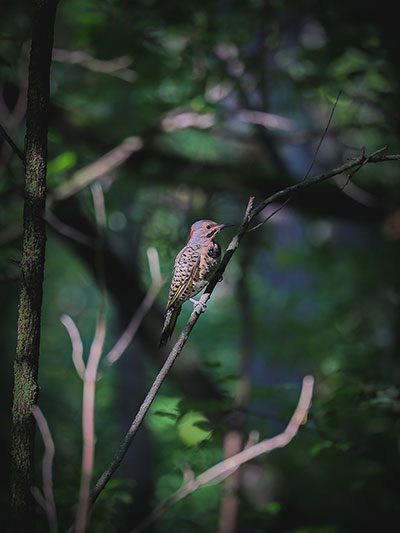
Northern flickers are medium-sized woodpeckers and are the only member of their family to commonly perch on trees rather than clinging to them. They can be identified by their characteristic red breast and black belly band. The males have a red moustache mark which distinguishes them from the females. Both sexes have a brown back with black bars. Their wings show yellow underparts when they fly.
Flickers are ground-feeding woodpeckers and eat ants and beetles, which they find by probing beneath the ground with their long tongues. Most woodpeckers have tongues that are adapted to spear and extract insects from wood, but the flicker’s tongue is a bit different and helps it lap up large numbers of ants. In winter, they also eat fruits and nuts. Suet feeders and platform feeders with whole nuts on it can attract Northern Flickers to your garden.
Northern Flickers are not migratory birds in California, but they may move around to find food or mates.
9. Ash-throated Flycatcher
Ash-throated Flycatchers are grayish brown in color, with a pale-yellow belly and cinnamon edges of the wings. There is a broad stroke of cinnamon down the center of the tail, not quite reaching to the tip. The cinnamon stroke is bordered by brownish gray. The wings are marked by two white wing bars, and they have a whitish throat. The males and females look similar. They tend to lean forward on perches and will move their heads up and down, particularly when they are agitated.
Ash-throated Flycatchers arrive in breeding areas of Southern California as early as March. They migrate south of Mexico in the winter. The Ash-throated Flycatcher is a backyard bird common in California. It can also be found in open woodlands, chaparral, and oak savannahs. They feed on insects, spiders, and other invertebrates.
10. American Goldfinch

American goldfinches are small songbirds with yellow plumage and black wings. They have a black bill and are about the size of a sparrow. American goldfinches are known for their cheerful song.
American Goldfinches are popular birds with the males’ bright yellow and black coloring in spring. The females are duller brown, as are males in winter.
They can be found in fields and overgrown area. They forage for sunflower, thistle, and aster plants. They are also common in suburbs, parks, and backyards.
American goldfinches are not migratory birds in California, but they may move around to find food or mates.
11. Lesser Goldfinch

Lesser Goldfinches are small songbirds that are common backyard birds, mostly found in California and Texas, although small populations can be found throughout the USA. They are not migratory birds in California, but they may move around to find food or mates. They are known for the cheerful song.
Male Lesser Goldfinches are yellow-brown on their back and underbelly with a black streak going down the center of their face. Females have brown heads with tan upper parts, while males have deep brown heads with olive upper parts.
They can be found in large flocks in open habitats, including thickets, weedy fields, forest clearings, parks, and gardens. Lesser goldfinches eat a variety of seeds, fruits, and insects. They often feed on thistle seeds and sunflower seeds.
12. Black-headed Grosbeak
The Black-headed Grosbeak is a small songbird found in western North America. They have joyful song. They Breed in Northern California and may migrate to Southern California and Mexico in the winter. The males tend to migrate south before females and young, and then return earlier in spring.
The males are cinnamon coloured with black and white wings and a black cap, while the females are less colorful.
There heavy bills enable them to feed effortlessly on sunflower seeds.
An interesting fact is that in central Mexico, where monarch butterflies and Black-headed Grosbeaks both spend the winter, grosbeaks are one of the few predators that can eat the butterflies whose toxins make them poisonous to most birds. Black-headed Grosbeaks feed on monarch butterflies more or less in 8-day cycles, which gives their bodies time to eliminate the toxins.
13. Allen’s Hummingbird
Allen’s Hummingbird is a small hummingbird that migrate to Mexico in the winter although some may stay in Southern California year-round. They breed along a narrow strip of scrub along the Pacific Coast.
The males have greenish upperparts and heads with coppery, reddish-orange throats. The females are less conspicuous with grayish upperparts and whitish underparts. The birds were named after Charles Lewis Allen, an American ornithologist. The habitat of Allen’s Hummingbird is chaparral, scrubland, and woodland and their diet consists of insects and nectar. They are common backyard birds in California.
14. Anna’s Hummingbird

Anna’s Hummingbirds are among the most common hummingbirds along the Pacific Coast of California is the Anna’s Hummingbird. These beautiful creatures are small and can often be seen darting around gardens and backyard feeders. Anna’s Hummingbirds are found in a variety of habitats across California, including urban areas, chaparral, and woodlands. Migration patterns vary for Anna’s Hummingbirds, but many birds in California will head to Mexico for the winter months.
The males have iridescent emerald feathers and rose-pink throats that sparkle. They are no bigger than a ping-pong ball. The females are metallic emerald green on the back with grayish feathers in front and a tinge of pink on the throat.
They primarily feed on nectar from flowers but will also eat insects for protein.
15. Blue Jay
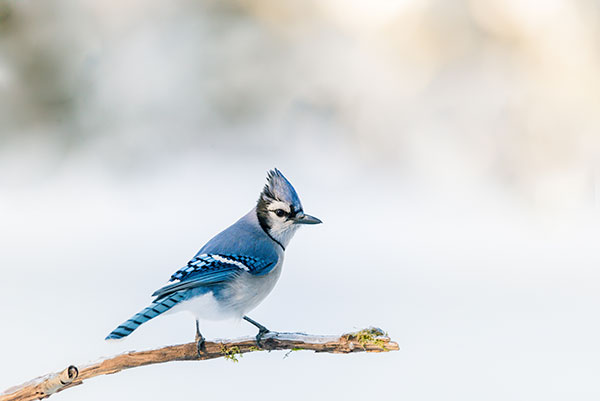
The Blue Jay is a medium sized bird and is a member of the crow family and are native to North America. The blue jay is found in woodlands, gardens, and backyards. It feeds on insects, acorns, fruits, and nuts. The blue jay migrates in flocks to southern California in the winter.
They have a long, pointed tail and a crest. The head, wings and back are blue while the chest is white. Both genders have similar features, but the female is slightly smaller in size than the male.
Blue jays are known to be egg thieves, sometimes directly taking eggs from nests and other times following the special sounds made by parent birds.
16. California Scrub Jay
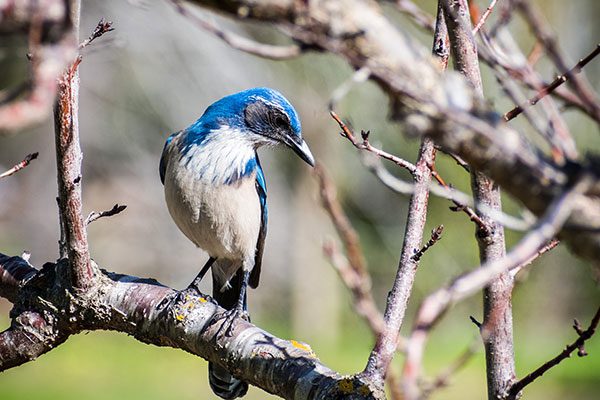
The California Scrub Jay used to be known as the Western Scrub Jay. It is a common bird visiting backyard bird feeders throughout California and is also known for its loud, raucous calls. Scrub Jays are found in a variety of habitats including urban areas, forests, and scrublands. California Scrub Jays are non-migratory birds but may move to lower elevations in the winter.
They are easily recognizable with their blue plumage and white chest. Unlike Steller’s Jay, they do not have a crest. The tail is long the bill is straight and stout, with a hook at the tip. There is little differentiation between the sexes.
Their diet consists of insects, but they will also eat fruits and berries.
17. Steller’s Jay
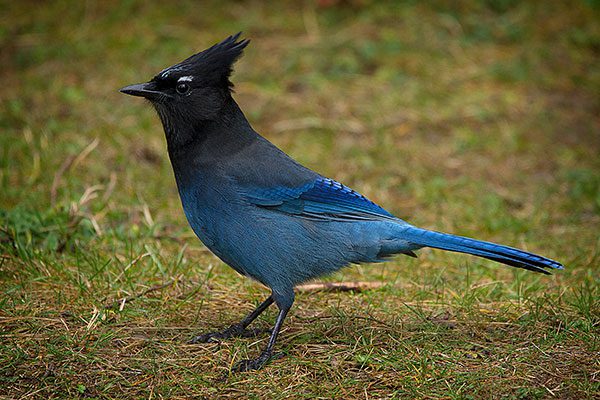
The Steller’s Jay is a striking bird with bold blue and black plumage. They typically migrate in flocks and can often be seen flying in formation. In California, they are most commonly found in the Sierra Nevada mountains. Being a member of the crow family, they are excellent at mimicry.
The Steller’s Jay shows a great deal of variation in appearance throughout its range, with some populations featuring black crests and backs, and others blue. A close look at these birds shows a mix of azure and blue. They are named after George Steller, a naturalist who discovered them in the 1700’s
They build their nests with mud. Like many other Jay species, they are nest-robbers too and are also known to kill small adult birds too.
It is common to see these birds in backyard habitats, as they are known to be attracted to feeders. Their diet consists of various nuts and seeds, as well as insects.
18. Dark-eyed Junco
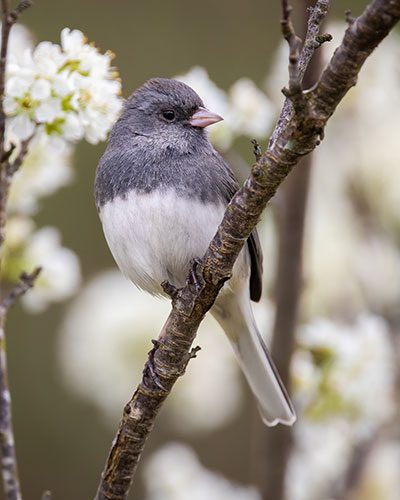
The Dark-eyed Junco is found in a variety of habitats, including forests, woodlands, brushy areas, and at backyard bird feeders. They are migratory bird, spending the summer in the mountains of California and mostly commonly in the Sierra Nevada and Cascade mountain ranges. They winter in lower elevations or even coastal areas, although some birds do remain in higher elevations year-round. They often form flocks outside of breeding season.
The Dark-eyed Junco is a medium-sized sparrow with a rounded head, short bill, and long tail. The upperparts are grayish brown, and the underparts are whitish with dark streaks on the sides. The juncos breeding in California mountains have darker gray upperparts and more distinct streaking than those of other regions. The female is usually duller than the male. Both sexes have pinkish brown legs and feet.
Diet consists mostly of insects and seeds. In winter, when insects are scarce, they will eat more berries and fruits.
19. Ruby-crowned Kinglet

The Ruby-crowned Kinglet is a tiny songbird that is found in woodlands throughout North America. They typically migrate to southern Mexico and Central America for the winter months. During the breeding season, Ruby-crowned Kinglets are found in forests across California. They build their nests in coniferous trees, often high up in the branches.
The male has a striking ruby-red crown, while the female’s crown is more subdued. These little birds are constantly on the move as they forage for insects among the branches and leaves. In winter, they often form large flocks and can be seen in backyard bird feeders.
As backyard birds they are not particularly shy and will often approach humans if they think there is food available. Ruby-crowned Kinglets eat a diet of insects, spiders, and other small invertebrates. In winter, they will also consume small fruits and berries. To attract these birds to your garden, put out a mix of sunflower seeds and insects.
20. Horned Lark
The Horned Lark is a small songbird that is found in open habitats throughout North America. These birds are usually found in open fields, meadows, and other grassy areas. In winter, they often gather in large flocks and can be seen in backyard bird feeders. Horned Larks typically migrate to southern Mexico and Central America for the winter months.
The male has a black stripe through its eyes and two yellow “horns” on its head. Females lack the horns, but they do have a black stripe through their eyes.
They build their nests on the ground, often hidden among the grasses.
Horned Larks are not shy and will often approach humans if they think there is food available. Their diet consists of insects, spiders, and other small invertebrates. In winter, they will also consume small fruits and berries.
21. Northern Mockingbird

Northern Mockingbirds are good at mimicking other animals, sirens, and crickets, as well as their own species. Studies have shown that they can sing up to 200 songs, including the songs of other creatures like birds, frogs, and other animals. Mockingbirds are non-migratory birds but may move to lower elevations in the winter. Mockingbirds are found in a variety of habitats including urban areas, forests, and scrublands. Their diet consists mainly of insects, but they will also eat fruits and berries.
Northern Mockingbirds are easily recognizable with their grey plumage and white wing bars.
They are common in backyards are not often found around bird feeders. To encourage Mockingbirds to visit your keep the lawn open and provide fruit trees such as mulberries, hawthorns, and blackberry brambles.
22. Black Phoebe
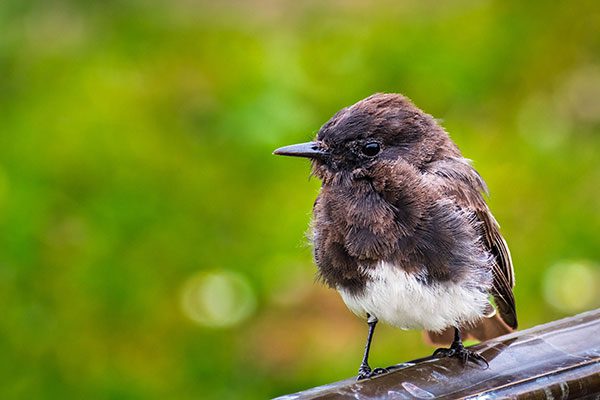
The Black Phoebe is a small passerine bird in the flycatcher family. This bird is typically found nesting in colonies near streams, rivers, ponds, or lakes. Its nest is a mud cup attached to a vertical surface such as a cliff, building, or bridge support. It is a permanent resident in much of its range, but some may migrate more south in winter. The black phoebe is a fairly common backyard bird in California.
Both sexes have similar plumage. They are about six inches long with a black body and wings, white belly, and a long tail that is often cocked. The bill and legs are black.
Black Phoebes have a slow wing beat and often hover above water before dipping down to catch prey. They often perch on low branches or wires and make quick sallies to snatch insects in mid-air.
23. California Quail
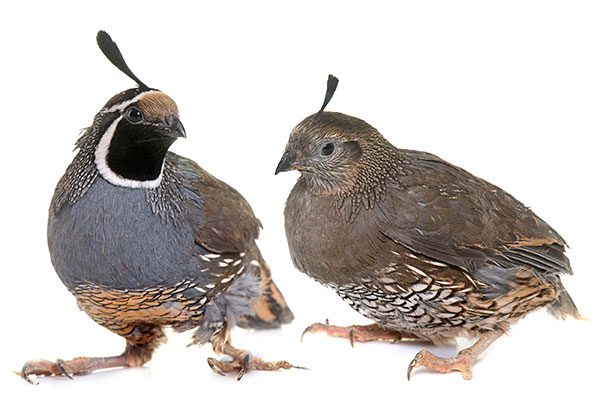
The California Quail is the state bird of California since 1931. It is a small ground-dwelling bird. California Quails are highly social and often gather in large flocks. They are found in chaparral, sagebrush, oak woodlands, and the foothill forests year-round in California.
California Quails plump short-necked ground birds and have a small head and bill. The have short and very broad wings. Males are a rich gray and brown, with a black face with bold white stripes. Females are plainer and do not have facial markings. Both males and females have a comma-shaped feathers projecting forward from their foreheads and a pattern of white, cream, and chestnut scales on their bellies.
California Quails eat a variety of seeds, leaves, and insects. Being tolerant of people, they are common birds in parks, gardens, and agricultural areas. A way to attract them to your garden is to sprinkle seed or grain on the ground near shrubbery.
During the breeding season, California Quails form monogamous pairs and nest on the ground. The female lays about 12 eggs, which hatch after about two weeks. The young are able to fly and fend for themselves within a few weeks.
24. Common Raven

The Common Raven is the largest member of the crow family. It can be found in woodlands, mountains, and deserts across North America. In California, they are most commonly found in the Sierra Nevada mountains.
They are all black with a glossy sheen.
Ravens are scavengers and will eat about anything, from rodents to other birds. They are also known to cache food for later. Ravens are not migratory but will move to new areas if food becomes scarce. Common Ravens are protected under the Migratory Bird Treaty Act.
25. American Robin

The American Robin is a backyard bird that is common in most of North America. They will also eat berries and fruits. American Robins are one of the first birds to sing in the morning. They migrate south to Mexico and Central America in the fall.
Male and female American Robins look different from each other. Male robins have orange breasts, while female robins have grayish-brown breasts. Male robins also tend to be larger than the females.
In California, they are often found in woodlands near water where they can find their favorite food – insects!
26. Golden Crowned Sparrow
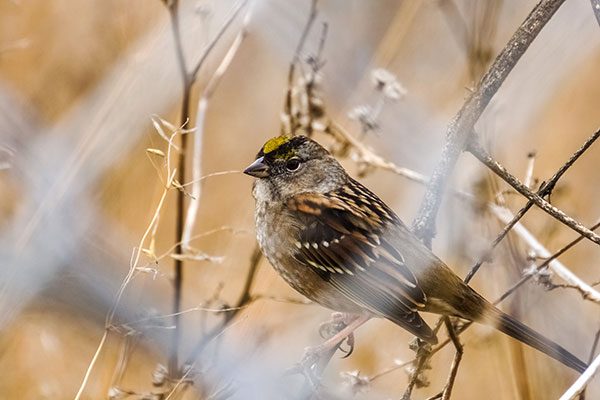
The Golden Crowned Sparrow is a commonly seen backyard bird in California. It is usually found near water sources in open woodlands, scrublands, and in gardens. In California, the Golden-crowned sparrow is a year-round resident, but some may migrate to lower elevations for the winter.
This sparrow can be identified by its striking yellow crown, which is bordered by black streaks. The rest of its body is gray and white with rusty brown wings.
The diet of the Golden Crowned Sparrow consists of seeds, insects, and berries.
27. House Sparrow

The House Sparrow originated in Europe. It was introduced to North America in the 1850’s and is now one of the most common birds. In California, it is found throughout the state year-round, although some may migrate south in winter.
It is a small bird with a stout bill and streaked upperparts. The male has a gray head and chest with black streaks on the throat, while the female is brownish overall. It is not a singing sparrow, but chirps when issuing a warning.
The House Sparrow feeds on a variety of foods, including seeds, insects, and garbage. In backyard bird feeders, it will eat about anything, from sunflower seeds to suet.
28. Song Sparrow

The Song Sparrow is another backyard bird commonly found in California. As their name suggests, these sparrows are known for their beautiful song, which they use to attract mates and ward off predators.
In California, they do not migrate. They typically nest in trees and bushes but prefer open areas with some bushes or trees nearby. This provides them with places to hide from predators and build their nests.
The Song Sparrow is a medium-sized bird with streaked brown upperparts and whitish underparts. The male has a gray breast and head, while the female has duller colors. Both sexes have a reddish-brown mark on their throats called a “throat patch.” This patch is larger in males and is used to attract mates. Male Song Sparrows also have a dark brown streak on their heads that is not present in females. This streak is used to intimidate other males during the breeding season. Male Song Sparrows also tend to be larger than females.
The two sexes sing different songs, with male songs being longer and more complex. Male song sparrows also sing more often than females, which is how they attract mates. Females usually only sing when they are defending their territory or attracting a mate.
The diet of the Song Sparrow consists of insects, spiders, and seeds.
29. White Crowned Sparrow (Nuttalli)
The White Crowned Sparrow (nuttalli) is found all year-round in woodlands, gardens, and farmlands in California. They move in flocks.
It has a black-and-white head, pale beak, and crisp gray breast.
The diet of the White Crowned Sparrow consists of insects, seeds, and berries.
30. European Starling

European starlings are common backyard birds in California, particularly in winter. European starlings migrating through the state can be seen in flocks of hundreds or even thousands of birds flying together in formation. These birds eat insects, berries, and fruits. You may see them eating bugs in your garden or picking berries from bushes.
European starlings are also known for their mimicry and can imitate the sounds of other birds and animals.
They are small birds with black feathers, a short tail, and pointed wings. Their beaks are yellow with a black tip, and their eyes are dark brown. At a distance, starlings appear black. In summer, they turn an iridescent purplish green with yellow beaks; in winter, their plumage is brown, covered in brilliant white spots.
In flight their wings are short and pointed, giving them a star-like appearance, and hence the name “starling”.
31. Oak Titmouse
The Oak Titmouse is a common backyard bird in California that can be found in woodlands and gardens. In the winter, they migrate to lower elevations in search of food.
They are small songbirds with gray-brown upperparts and slightly lighter underparts. They have short, stubby bills and a short crest on their heads with a medium-long tail.
Their diet consists of insects, spiders, and berries.
32. California Towhee
The California towhee is a common backyard bird in California. They are known to challenge their own reflections knock on windows and car mirrors as they peck at their opponent.
They are large sparrows, with a sparrow’s that are larger and bulkier than other sparrows, have rounded wings, a long tail, and a thick, seed-cracking beak. The long tail and short wings can make this bird look unstable in flight.
They are matte brown all over, except for a rusty patch under the tail. Males look the same as females.
The diet of the California towhee consists mostly of insects and seeds. The bird migrates to lower elevations in winter.
33. Spotted Towhee
This bird is a year-round resident in California. It can be found in the mountains, foothills, and front range. The Spotted Towhee prefers brushy areas with thick cover. Diet consists of mostly insects but also eat some fruits and seeds. Look for this bird scratching the ground for food or perched on a low branch surveying its surroundings.
The Spotted Towhee is dark brown with black streaks on its back and has a white belly. The wings are brown with white spots. The tail is long and black with white stripes. The bill is black, and the legs are pink. The female Spotted Towhee is similar to the male but has no spots on its wings.
They breed in open woods and brushy areas in western North America. It nests in trees or shrubs, laying four to six eggs. The diet of this bird consists of insects, berries, and seeds. They form small flocks and can be seen feeding in open areas.
34. Yellow-rumped Warbler

Yellow-rumped Warblers can be found year-round in northern parts of California or as winter visitors in the central and south
Males are gray with flashes of yellow on the face, sides, and rump, and have white in the wings. Females may be slightly brown, and winter birds are paler brown with bright yellow rumps and sides turning bright yellow and gray again in spring.
The Yellow-rumped Warbler eats insects, spiders, and berries. In the winter, this bird eats mainly fruit. The Yellow-rumped Warbler is one of the few backyard birds that can eat wax myrtle berries. This bird is also known to eat poison ivy berries
35. Bewick’s Wren
The Bewick’s Wren is a small noisy and somewhat hyperactive songbird that inhabits brushy areas in open woods and chaparral throughout California and is a non-migratory resident. It breeds from late March through August, building a cup nest of moss, spider webs, grass, and hair lined with feathers.
It has buffy upperparts, white underparts, and a streaked back. The head is gray with a black stripe through the eye and a prominent white eyebrow, with a long tail that is frequently cocked upward.
It forages on the ground in leaf litter or low in shrubs, picking up insects with its bill.
No matter where you are in California, you can spot some of these beautiful backyard birds!
FAQ
What can I do to encourage wild birds in my yard?
In order to encourage wild birds in your backyard, you must provide a source of water and food. This can be done with bird baths and bird feeders. For a more natural experience, try adding some flowers or plants around your yard to attract different species of birds.
How do I identify the birds around my backyard in California?
The best way to identify the birds in your backyard is by looking at their feathers. Their beaks tell you what they like to eat. Their feet tell you if they perch, hop or wade.
What birds are most common in California?
For birders, California is one of the best winter birding locations in North America. 35 of the Most Common Backyard Birds in California will give you a small preview of what you can find in the State.
Why might there be lots of small birds flying and diving?
It is possible that the birds are looking for food such as flying insects or there could be a predator nearby. Without further observations it is impossible to know what is driving their behavior.
What kind of blackbirds seem to congregate on power lines?
Blackbirds are a common sight at power lines, but why? Scientists believe that the blackbirds congregate at these power lines because this is an excellent place to find food. The electricity can kill bugs, which the blackbirds can easily feed on.
Where can you spot Roadrunners?
If you live in the Southern California region, you may be lucky enough to spot a Roadrunner. These unique birds are known for their long legs and tails, and they can often be seen running along roadsides in search of insects.